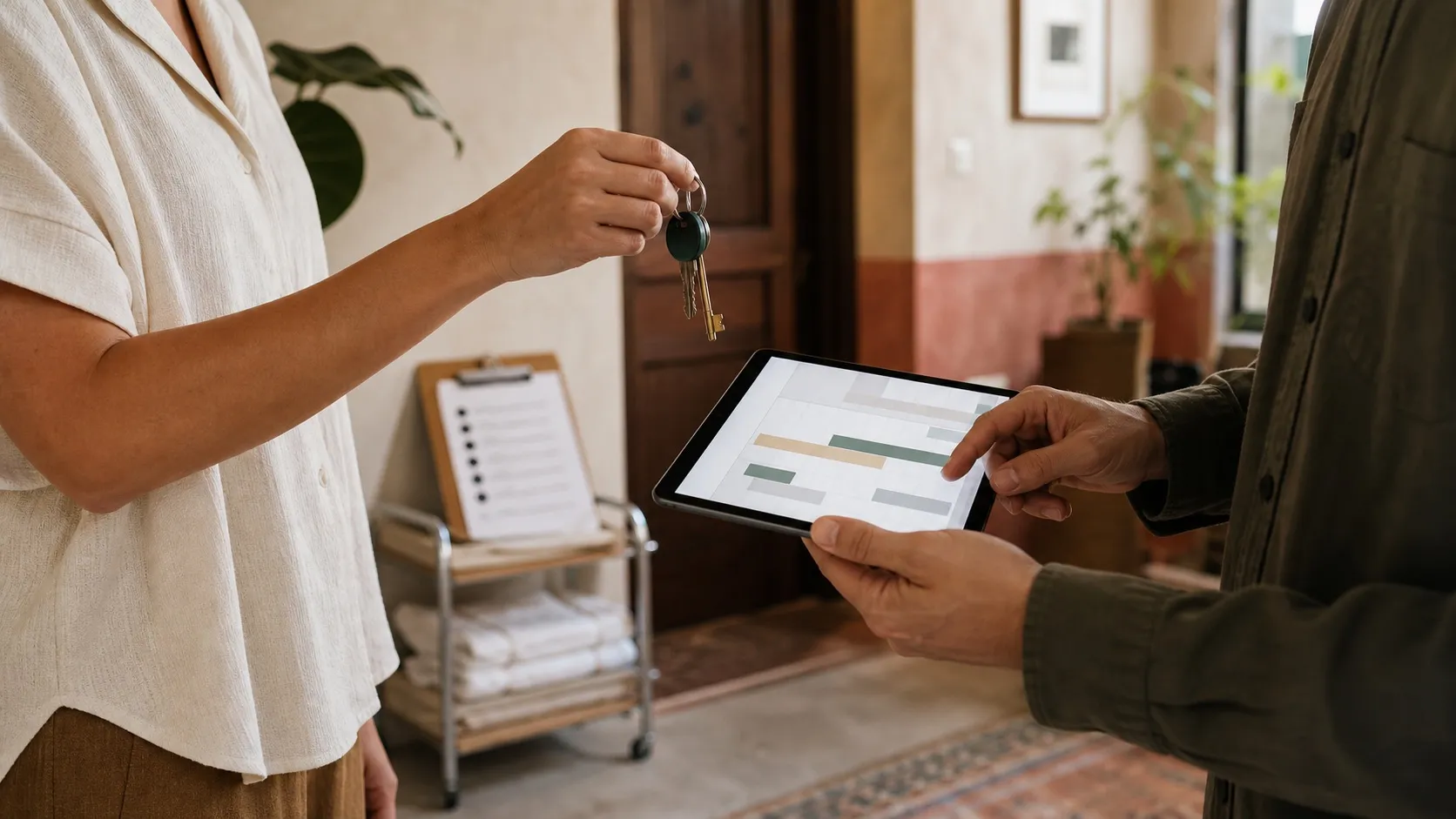
Half the work of a short-term rental happens on a phone: messages, pricing, the calendar, reviews. The other half happens inside the apartment and can't be done over a video call.
Owners who live elsewhere usually handle the first half well and underestimate the second. This guide separates the two, then covers what doesn't depend on operations: tax IDs, the city registry, power of attorney, the account and payouts.
Where we cite a rule, the source is named. Where the answer depends on your tax residence or immigration status, we say so, because that's for your accountant or notary to decide.
What works remotely and what needs someone local
This table is operating judgment, not a legal rule. It comes from the day-to-day running of our own units.
| Task | From abroad | Needs someone in the city |
|---|---|---|
| Messages, pricing, calendar | Yes, fully | No |
| Guest access | Temporary codes on a smart lock | The backup: a physical key and someone who shows up if the lock fails |
| Cleaning and inspection | Photos and the team's checklist | Yes, at every checkout |
| Maintenance | Approving quotes and payments | Diagnosing, letting the technician in, checking the work |
| Emergencies | No real fix | A leak, a power cut, a guest locked out: someone within minutes |
| Inventory | Reviewing the list and photos | Counting linens, checking damage, restocking |
A smart lock solves key handoff, not failures. What it needs so nobody is left at the door is in our guide to remote check-in and smart locks (in Spanish).
The emergencies row matters most. A leak at 2 a.m. with guests inside won't wait for your flight. Without someone holding a key and the authority to act, the apartment isn't ready for short-term rental.
Cleaning can't be left to the building doorman's goodwill either. How we organize it between stays is in cleaning with an in-house team (in Spanish).
The paperwork that stays with you, even from abroad
Handing over operations doesn't hand over your obligations. The listing, the income and the registration remain in your name, and several procedures need your details or your signature.
RFC and platform withholding
The SAT, Mexico's tax authority, says individuals who provide lodging through platforms must register for an RFC (Mexican taxpayer ID) and give it to the platform. Airbnb asks hosts to register it to get the lowest withholding.
Without a registered RFC, Airbnb withholds income tax and VAT at higher rates. How it works, without made-up percentages, is in our guide to Airbnb taxes in Mexico City.
Foreigners apply for an RFC by appointment at the SAT, with immigration documents. According to ContadorMx (checked October 29, 2026), the requirements are in form 1/CFF of Annex 2 of the Resolución Miscelánea Fiscal.
If you don't live in Mexico, there's an earlier question: your tax residence. It isn't the same as nationality. A foreigner with a home in Mexico can be a Mexican tax resident under Article 9 of the Federal Tax Code.
For a tax resident abroad, the general Income Tax Law rule on rent from Mexican real estate is 25% withheld on gross income (Article 158), unless a tax treaty says otherwise, according to IDC Online (December 2022).
We couldn't confirm in an official source how that combines with Airbnb's withholding. It's the first question for your accountant, before you list, not when the annual return is due.
The host registry and Llave CDMX
Registration in the city's short-term rental host registry is done online with Llave CDMX. It asks for your RFC, proof of tax status, no outstanding property tax or water bills, insurance and ID, among other documents.
The official Llave CDMX user guide has a section on creating an account as a foreigner without a CURP (Mexico's population ID). We couldn't read the full steps; check the guide before assuming you need a CURP.
The portal also provides for representatives or intermediaries. The step-by-step, and how to split the procedure with a manager, is in Mexico City host registration, step by step.
Power of attorney, only if someone signs for you
You don't need a power of attorney for someone to answer messages or schedule cleanings. You need one if that person will sign on your behalf: a government procedure, a supplier contract or something with the condo board.
According to the Mexican consulate in Vancouver (SRE), a power granted at a Mexican consulate is valid in Mexico without legalization or an apostille. If a foreign notary signs it, it needs an apostille or legalization.
Two types are worth keeping apart. A power for acts of administration lets someone manage the property; one for acts of ownership (actos de dominio) lets them sell or mortgage it. Running a short-term rental only needs the first.
Our rule: a special power, limited to the procedures you actually need and with an end date. Have a Mexican notary review it before you sign it abroad.
Your own Airbnb account or the manager's
Some operators list your apartment under their own account. It's convenient at the start and costly at the exit: the listing, reviews and history sit in an account you don't control.
The other problem is tax. Withholding and certificates are issued to the account holder, not the property owner. Your accountant will have to explain income that doesn't appear in your name.
The alternative is the co-host role. You hold the account, the manager joins with defined permissions, and according to Airbnb's help center co-hosts can't see the owner's tax or payout information.
Which permissions to grant and which to keep is in how to be a co-host on Airbnb (in Spanish). What the contract should say about the account and the exit is in the contract with your manager (in Spanish).
How to get paid from abroad
Your payout method is set in your Airbnb account, in the payments section. The methods available depend on your country and the bank account's; check them there before choosing. How Airbnb works for owners explains how payouts arrive.
Airbnb lets you split payouts across several methods, by listing or by percentage. It also lets the account holder share a percentage or a fixed amount of each booking with a co-host.
According to its help center, only the account holder sets up that split, the co-host must accept it and gets paid after guest check-in. There are regional restrictions depending on where the host, co-host and listing are.
Our rule under any arrangement: the money reaches your account first and the fee comes out of it. If the operator collects everything and transfers later, you lose sight of the real income.
If your bank account is outside Mexico, expect currency conversion and possibly bank fees. They aren't part of operations, but they are part of your net; ask your bank what it charges to receive.
How to read the monthly report when you can't go look
From a distance, the monthly report is all you have to know whether things are going well. How we build ours is in the anatomy of our monthly report (in Spanish); here's how to check it.
- Compare gross income with the transaction history in your own Airbnb account. They should match booking by booking.
- Check that occupied nights match the calendar. A blocked night with no explanation is a question.
- Read expenses by category. Cleaning per turnover, maintenance with receipts and the management fee on its own line.
- Look for the repairs you approved. If a large expense shows up that you didn't authorize, the report should explain why.
- Read the month's reviews. They're the only way to know the apartment's condition without walking in.
If one month you can't reconcile the report with your Airbnb account, the format isn't the problem. It's the first sign that the account or the payouts aren't in your name.
Co-host or full-service management
The decision depends less on the percentage and more on who covers the right-hand column of the table above: cleaning, maintenance, emergencies and inventory.
- An individual co-host works if they live nearby and have a key and time, and if you accept there's no backup when they're sick or traveling.
- Management that only runs the digital side (listing, pricing, guests) works if you already have someone in the city to clean, hand over keys and let technicians in.
- Full-service management also covers the on-site work. For owners living abroad it's the most common case, because nobody else is left to do it.
Roma Norte Host has two plans: Essential, 12% of lodging income, for owners who already have a local team; and Full-service (Integral), 20%, with cleaning, keys, maintenance and a monthly report.
Airbnb's fee, per-stay cleaning, supplies and taxes are owner expenses and are itemized in writing before signing. Market ranges are in how much an Airbnb manager charges in Mexico City.
What to do before renting from abroad
- Settle your tax residence with an accountant and get your RFC before listing.
- Open or keep the Airbnb account in your name, with your own payout method.
- Decide who holds the backup key and who handles emergencies, with a name and a phone number.
- Put together the registry file and agree in writing who files it and who keeps the registration number.
- If someone will sign for you, grant a limited power for acts of administration, not one of ownership.
- Ask for a monthly report you can reconcile against your own account.
The bottom line: from abroad you can see everything, but you can't reach anything. Before the first guest arrives, someone in the city has to be able to get there, and you have to be able to verify what they did.
Sources checked on October 29, 2026:
- SAT, individuals earning income through platforms (reviewed July 31, 2026; in Spanish).
- Airbnb, taxes in Mexico and RFC; splitting payouts; co-host payouts.
- Mexico City host registry portal and the Llave CDMX user guide (in Spanish).
- SRE, Mexican consulate in Vancouver: powers of attorney.
- IDC Online, nonresidents with rental income (Dec 15, 2022) and ContadorMx, RFC for foreigners (in Spanish).
We couldn't open Airbnb's help pages directly while writing this guide; what we cite comes from their indexed articles. Confirm it there before acting, because Airbnb updates them without notice.
This is operating context, not tax, immigration or notarial advice. Review your case with an accountant and a notary.
This is the English edition of our Spanish guide, written for owners who prefer to read in English.